
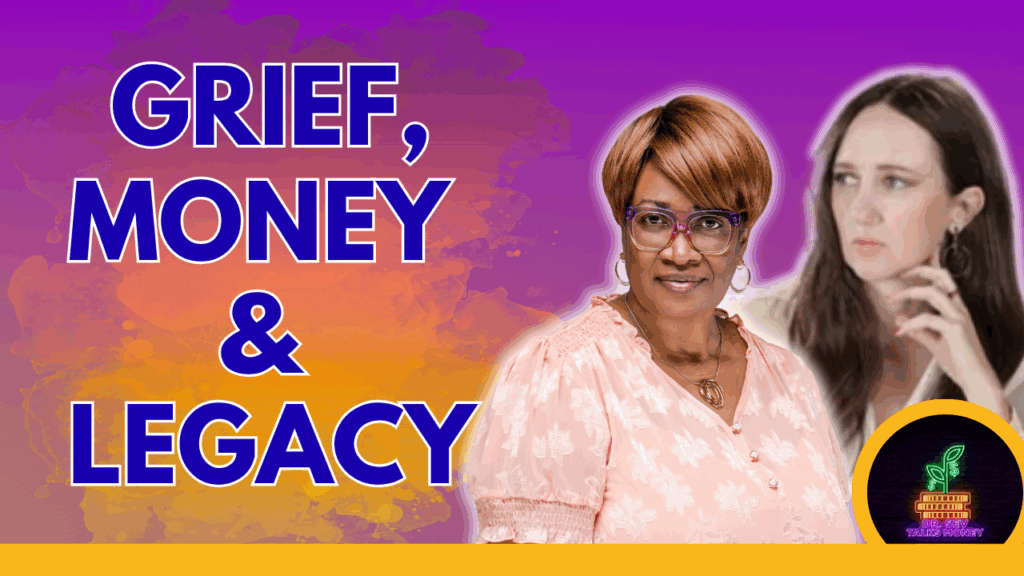
What happens when grief turns into guidance? In this episode, Sarah Brady shares her deeply personal story of surviving a 74-car accident that took her father’s life, and receiving a six-figure wrongful death settlement at just 17. She opens up about the emotional complexity of grief and money, the mistakes she made with her windfall, and the importance of preparing for the unexpected through wills, estate planning, and honest conversations. This conversation is a powerful reminder that financial education must meet people with empathy, and that preparing your legacy is one of the greatest gifts you can leave behind.
Sarah is a nationally recognized credit and finance expert, writer, and former certified credit and housing counselor. Since 2016, she’s written trusted personal finance content for top outlets like Forbes Advisor, Yahoo! Finance, USA Today Blueprint, Experian, Credit Karma, and Investopedia. With a background in loan underwriting, SEO content, and financial education, Sarah makes complex money topics clear and relatable, especially around credit, debt, scams, and the emotional side of money.
Substack: https://sarahcbrady.substack.com/
LinkedIn: https://www.linkedin.com/in/scbrady
Estate planning websites mentioned in the recording:
************************************
The Dr. Sev Talks Money podcast’s mission is to empower women to approach money confidently, reframe their financial habits, and build a future where their money is a tool for opportunity and security.
Through Dr. Sev Talks Money YouTube channel and Podcast, I provide actionable advice and inspiration to help you achieve financial freedom.
Join me for one-on-one coaching, group sessions, workshops, or speaking engagements as we journey to financial empowerment together. It’s never too late to begin again—let’s make it happen!
Here is one way you can support the Dr. Sev Talks Money podcast and YouTube channel:
https://www.buymeacoffee.com/DrSevTalksMoney
My website: http://www.sevtalksmoney.com
YouTube: https://www.youtube.com/c/DrSeverineBryan–SevTalksMoney
LinkedIn: https://www.linkedin.com/in/severinebryan-financialcoach/
Transcript
Hey, hey, hey, Savvy Squad. Welcome to another episode of the Dr. Sev Talks Money, YouTube and podcast where we empower women to manage money confidently. Today’s conversation is tender and powerful. Sarah Brady survived a seventy-four car pile up at 15, the crash that took her father’s life, and later received a six figure wrongful debt settlement.
We’re talking about what really happens to money after loss, the mistakes, the lessons, and how you can protect the people you love. Because we’re discussing a fatal accident, I invite you to please take care while listening.
Sarah, welcome to the Dr. Sev Talks Money podcast. Thank you for having me. You are welcome.
Okay, I love to kick off with an ice breaker. So my question is what would we find in your wallet or purse that totally reflects your personality?
Thank you for having me by the way, and I agree.
Money is a weird, fun. Topic. It doesn’t always have to be serious. And I definitely have something in my wallet that reflects, the less serious side of my personality. Just to give you an explanation, I have a group of girlfriends that I’ve known for 20 something years and, decades ago we were talking about how we always came out looking bad in photos, and we decided, if you’re gonna look bad on accident, you might as well.
Look really bad on purpose for fun. So we have been for decades trying to outdo each other by taking like really ugly, horrible photos of ourselves. And even better if you can get it on a photo id. , I don’t know if you’ll be able to see ’em if I hold them up here, but I have a couple of photo ideas that are really bad and I’m very proud of them.
This one, if anybody’s listening has ever gotten their scuba diving certificate, I guess they have to take your ID photo right after you get out of the water on the last day of training. So, I was like, there’s no way I am gonna look good, so I’m just gonna go for it. So it’s, my scuba diving photo.
Hopefully there’s no personal information on there, but, I look like Squidward. And then I recently got a Costco membership. So here’s my, really beautiful. A Costco ID photo. I always get excited when it pops up on their big screen when I go into the store.
What about your wallet?
That’s so funny. I’m so boring. I’m thinking what’s in my wallet that reflects my personality. And I guess it has to be my notebook because I don’t go anywhere without a pen and a notebook. ’cause I’m always writing down ideas that come to me because if I don’t.
I’m like, I know I got a great idea. I don’t remember what it is. And it just never comes back the same way.
That makes sense to me. I’m pretty forgetful, so Yeah. I like to save my ideas.
Okay.
So before we jump into this topic, please introduce yourself to our listeners and tell us about your work as a personal finance professional.
Yeah, so I’m Sarah Brady. I’m a finance and credit expert. I’ve been working in the field of financial education, since I wanna say 2013. I’m a former, credit counselor certified by the National Foundation for Credit Counseling, and I’m a former HUD housing counselor. I’ve taught, home buyer workshops all over the city of San Francisco for their below market rate program. And, I have been a financial writer, for about nine years now.
I’ve written for many different publications and outlets, ranging from currently. Yahoo Finance. I write for Kiplinger. I’ve written for, Fortune, Forbes Advisor, Investopedia, Experian, AARP. Many different outlets and I love financial education.
Okay. Awesome. Now I think I read somewhere that you have a substack.
Do you want to tell us about that?
Or it might just be that I talk about it a lot. I just recently set up an account there, for anybody who wants to check it out. It’s at Sarah C. Brady. Middle initial is the letter C as in cat.
Just set it up, because I wanted, a platform to just talk a little bit more about money from a creative, weird, funny side, all the strange things about money in real life. I’m starting by sharing a series about how deportation and detention can impact your finances. So if you wanna check that out or you want to, follow or subscribe to get more content about kind of the funny, strange, interesting side of money, I would love to see you there.
So now we can jump into it. So we’re talking about. A unfortunately fatal accident that involved your dad. And how your life changed. So can you take us back to that day when your life changed? So. Drastically. What happened and how did it impact your family emotionally and financially?
Yeah.
So the accident that I was in, the date was November 14th, 1998. And, I was living with my mom. I was 15 years old and, but had gone for the weekend to visit my dad and, we were driving together to a softball event. And he used to coach and I played. So, we were in his truck and we were driving, on the freeway through, central California for anyone who’s familiar with the area.
It was between like Kingsburg and Reedley in central California. And, there was really dense fog that day. I was the only other person in the car and we were one of two vehicles that, that hit a diesel truck that was stopped in the middle of the freeway in the fog and in total there ended up being 74 cars involved.
There were two fatalities that day and my dad, died on impact.
Wow. Wow. That had to be an emotional, moment for you, not only because it was your dad, but also you’re at that stage in your life as a teenager. Yeah. This does not compensate for your dad losing his life, but at 17 you received a six figure settlement. What was it like to suddenly have that kind of money at such a young age? Mm-hmm. And again, going back to the grief is knowing that, okay, my dad is gone and it’s because of that, that I’m getting this money.
Talk us through that process.
Yeah. I appreciate you acknowledging, I guess it’s obvious, but it’s like the money doesn’t compensate. Right. I learned an unfortunate lesson because of the whole event and what went on. There was a big kind of legal storm that happened around me.
There was a scandal involving one of the drivers who caused most of the accident. And, what I saw happening is. People in my life, it almost felt like the grief over the loss for a lot of people was really channeled into thinking about money. And. I learned a, what I was gonna say a moment ago is I learned a lesson that I think is unfortunate and I still find it confusing years later, and I’ve had other losses in my immediate family.
But, I think for a lot of people when they are grieving, they may feel like money is one of the few things that is going to give them a sense of relief, you know? Mm-hmm. If I can maybe benefit from some of the assets that this person, had, or maybe if I have an inheritance, it might confirm for me the feeling that this person really valued me.
It might help me be set up for a better future. And so I think a lot of people lean into that, and that was really hard for me to watch at the age of 15, 16, 17. There was a lot of fallout in my family. In particular with my stepfamily, there was a lot of infighting. They ended up, my stepmom took me to court.
That’s a whole nother story for another day. But, it just was a whirlwind. And seeing the way that money, unfortunately, it’s almost like inextricably tied with someone dying. It was just mind boggling. I’m not sure if I answered your question exactly,
The last podcast episode that I published, actually it’s on YouTube, not on podcast yet. With, David Edey and he talks about money, what it does to people. Yeah. And there are people who don’t talk to each other over a cup.
After somebody passed away, there are people who don’t talk to each other over a chair. Yeah. Because they think they should have gotten that. We are learning that equal doesn’t mean fair to some people. So I can understand the emotional turmoil that caused because now all of a sudden there’s this money, and if I get this money, then it makes me feel better.
So even if I was mad at the person who died, if I get this money that’s going to soothe the anger, it’s going to soothe the hurt. So. Let’s talk about some of maybe the biggest mistakes that you made after getting that windfall and what you wish you had done differently.
Yeah. Part of what I learned from the experience is that people have what , I’ve come to call now, different money personalities and that helps me understand what was going on with my family and my own situation. My natural personality with money is I tend to be more of a hoarder.
My instinct is that I am kind of afraid to spend money. I wanna collect it and hide it away. I came from a pretty religious community, so I had also learned that thinking about money was bad. Wanting money was bad. I didn’t really have a framework, , I was really young.
Right. So you have kind of. Funny concepts anyway, but I just didn’t have a framework for what it would mean to be strategic with money and learn about it, in a way that could help me set myself up for the future. I just, I had this very black and white thinking. It was like, to think about it is to be obsessed about it and I don’t want to, let it rule my life.
And so one of the main mistakes that’s the overarching mistake I would say that I made is that. I let fear really motivate me and I avoided, learning, anything about how money works. , And I can get into a few more specifics. There are some things I did that I really regret, but that’s the overarching mistake I would say.
I’m not trying to psychoanalyze you, but I’m just wondering, my dad is gone and I got this because of him. It’s like I’m dishonoring him in a sense.
It’s like, no, I wanna hold onto this because it’s like holding onto my dad, with this money.
Yeah. I don’t know. I think that would be a natural response.
People do all kinds of funny things or, they have these funny stories in their minds. In my case I believe that a lot of us have these really strong narratives about money and there are these stories that we tell ourselves. And many times in my experience, you know, I used to be a credit counselor.
I’ve worked one-on-one with thousands of households. And what I have found is that a lot of people have these narratives about money in their mind that almost are a direct reflection of what they saw their parents doing with money and. I don’t wanna speak negatively about my dad, but I didn’t like the way that I saw him engaging with money.
Um, love my dad. But my parents were polar opposites in the way that they dealt with money. My mom didn’t have a lot and she really stretched it out, and she was very creative. And I didn’t know when I was young that my mom was broke, because she. Was very resourceful. My dad, on the other hand, I felt was more spendy going back to different money personalities.
He was somebody who worked very hard and I believe that for him the motivation was to be able to, go big, make large purchases, go on big vacations that sometimes to me felt like they were things that we couldn’t afford. And so again, at that age, really black and white thinking for me. And it was like, the way I interpreted that was being frugal is better and holding onto what you have is better. And I even took it so far as to say, well if I need less, then I won’t spend it and it’ll last longer. And so I really found myself over, the course of my early twenties, like really shrinking down my life smaller and smaller because I thought, the more frugal I am, the less I do, the longer this money is gonna last me. It was very, scarcity mindset, if you will.
Yeah. And I can imagine there are people listening who, maybe not that their parents passed away, but they got a windfall. Mm-hmm. And they may be thinking, similar things.
So looking back, what would’ve helped you most, maybe financially, emotionally, what do you think would’ve helped you most? And maybe this is something that may help somebody who’s currently going through this.
Yeah. I think that my mom tried to help. In a way, she did the best that she could with the resources that she had.
I remember her scheduling an appointment for me with, I believe it was some financial advisors and, they were just two older white men, and they were talking about money in a way that I didn’t understand. I don’t remember exactly what they said, but what I remember hearing and processing was they’re talking a lot about investing in the stock market and that seems really risky to me.
It seems really scary to me and I walked away from it and I just kind of. Fed that into the narrative that I already had. It’s like worrying about money is for people who are not like me. It’s for people who care about material things or care a lot about wealth, and I’m just not that person.
I hope I’m not getting too far off track with your question, but, I wish what I would have done in retrospect was. Made an effort to find people who spoke about money in a way that made sense to me. I couldn’t have known at the time, but I wish I would have looked for, resources and had the confidence in my ability to learn and educate myself and maybe taken some classes or, continued to look for people who spoke about money in a way that made sense to me. And, you and I talked about this before, but it’s also a bigger system issue. There just weren’t really readily available sources, this was 1999, 2000. We didn’t have social media, so I just thought these are the only kinds of folks you can go to if you wanna learn about money. And they were speaking a language that just didn’t make sense to me.
And as they, say, hindsight is 2020. And we don’t know what we don’t know, but hopefully from the lessons that you’ve learned, somebody listening will say, okay, yes, if I go to that advisor and they’re speaking over my head, then it doesn’t mean I’m dumb.
It just means that they’re not my advisor. I need to find one that I can relate to. So please, if you’re listening to us, find someone that speaks your language.
Yeah.
And that will not speak down to you and will break things down and will not make you feel intimidated about asking questions.
Absolutely. ’cause it’s your money, you know, ask all the questions you want and if they have a problem with that, they’re not your person. Absolutely.
Yeah. Yeah. It’s another reason too, now I really try to avoid using jargon. The language that we have that describes money, just basic financial concepts can be really confusing.
So, if you’re somebody who’s trying to learn how to deal with money and you just feel kind of overwhelmed by that, just echoing what you said, it’s not because you can’t understand it. Or these concepts are so complicated, don’t give up. Keep looking for, resources and people who explain it to you in a way that makes sense for you.
Yes, and one of the resources would be Sarah’s Substack. So, please make sure you are checking out her Substack. So if listeners can do one thing this week to prepare their families. In the event of a catastrophe. Yeah. What, would that something be?
Yeah. Well, if there’s something that I really want to impress upon folks, who are listening, I’ve seen this.
Again and again with people who I’ve counseled with close friends of mine, when there is a death in the family, there is often a lot of fallout about, the assets. Whether it be money or property, whether it be a business, my dad owned a business. The assets that belonged to your loved one who has passed away, there is often a lot of fallout about where those things are going and who, will inherit them.
And, all of that. And what I really want people to understand is that if you don’t. Leave a legal record of what your will is for the assets that you’ve worked so hard to accumulate. Then you can’t expect those things to go to the people that you have worked hard to earn them for.
That might be a funny way of phrasing that, but, if I can distill it down into something that’s easier to walk away with is, keep in mind that your word does not hold up. I had this experience many times. I think about my grandma who, had a big jewelry collection. She loved collecting jewelry. And she, over the years, would call in, myself and she’d call in my cousins and she would say, okay, this is where I got this ring from and when I pass away, I want you to have this one and this one is, special to me for this reason, and I want you to have this.
And then when she passed away that, desire of hers was not honored. There was somebody in the family who was closer to her assets and some of them just kind of vanished. Right? And, when you don’t make your intentions explicit through things like a written will through estate planning, you leave it up to fate.
And that is, something about human nature that I don’t like and I don’t completely understand. But I think that I’ve seen it time and time again. I’ve seen people liquidate assets in the matter of a day or two, and family members are left scrambling and wondering how to find the possessions that they believed were gonna come to them that are maybe sentimental or meaningful, liquidate businesses, you name it.
So. That’s a long-winded way of saying that you really need to have a will. You really need to take the time. And by comparison, it’s not a lot of time. If you pass away and your, assets go into probate, your family might spend months or years, thousands of dollars, waiting for judgments or even fighting each other to figure out, which assets go to whom and.
What I like to say, and I’ve, I know I’m being a bit long-winded here, but what something I’ve said to my mom is, don’t leave us with a fight. . Please, make it clear, not just through your words, because they may not be honored unfortunately, but get it into writing. We need legal documentation so that we know exactly what you want.
Yes. One of the best ways to show our love for loved ones is making sure. That we have our documents in order so that when you pass, we are not grieving. Plus trying to figure out what you wanted. Yes. You know, and that those become intertwined with grieving and trying to figure out what you want.
And there’s always going to be one or two persons in the family. Mm-hmm. Who will do nefarious deeds. There’s always gonna be one or two
I’m sad to say it, but that has absolutely been, my experience is that it is. Maybe I’m just not. Talking to the folks who have really, healthy family dynamics and they’re all on, on the same page and everybody’s being really fair.
But I just have seen people do go through really horrible things and go through a lot of pain. And the last thing that you wanna do is leave in your wake. Love lost. Between relatives because somebody believed that you intended for them to have a house or you intended for them to have a vehicle, but you didn’t, give them the legal means to keep those things.
Yes. It is very sad. And there are people even who are not family members. There’s one case where when I spoke with David Edey, this lady would come over and she would help, the person who was deceased. And by the time the family members came, she cleaned out the house.
Ugh. And she wasn’t even on the will. She wasn’t even family members. So money makes people act a fool. And, so we have to make sure that not only are we putting it in a will, but we’re having a family conversation too. Yeah. So that if I’m getting something that somebody else thinks they should have gotten, they’re aware of it.
That it’s not just in the will. Yeah. But we are having that discussion and so when it happens and it’s in the will, they’re not surprised. Yeah. So with those kinds of conversations we may wanna have with our family members and they’re hard conversations. Yeah. They’re hard necessary conversations.
Yeah.
You know, like I mentioned, I’ve been in an ongoing conversation with my mom for years now because I learned this lesson at a young age. And what I would say is think about what if someone in your life comes to you and tells you, Hey, when I pass away, I want you to have this, you can.
Respond by expressing your gratitude. That’s an incredible thing for someone to do, is to leave you an asset that they’ve worked hard to cultivate. But follow that up by saying, have you put it in your will? Is there a legal record that will let us know when you pass away that this is meant to go to me?
Because if not, it may not fall into the hands that you want it to. Yeah. Those are tough conversations to have because let’s just face it, people don’t like thinking about dying. Yeah. And, sometimes it, may take a few tries. , If you’re bringing it up to your parents, for example, it’s important to make sure that they understand, I’m not talking about this because I’m sitting here waiting, you know?
Yeah. There’s nothing that can, take the place of, a loved one when they passed, but you’re bringing it up because you wanna make sure that their wishes are respected, and that there’s not any infighting, yeah.
And taking that stance of, Hey, I just wanna make sure that when you pass away, whatever you desire is going to happen and you’re not gonna be here, but I wanna make sure we honor you by honoring your wishes and, and having those conversations in that context.
And, that of course, also depends on the relationship you have with the person. Because if you don’t have a close relationship and then all of a sudden you’re talking about assets. Yes. They may not be receptive. Right. So, make sure that you have the kind of relationship that allows you to have this kind of conversation with the person, because you want to remind them they work hard and you don’t want the lawyers to get half of whatever it is they have when they pass away because things are not in order.
Yeah. One of the examples I didn’t mention before is when my dad passed away, he had not updated his life insurance policy. So my step siblings who were his dependents were not included. And, quite frankly, I don’t believe that would have been what he wanted. I believe that he would have, wanted to make sure that they were taken care of as well.
So, you know, the consequences can be. Very serious for your loved ones. Especially thinking about people who have, who have dependents. There are some great resources online. I was just speaking to, A CFP, A Certified Financial Planner, recently. Her name is Jane Mepham, M-E-P-H-A-M. And she actually shared a couple of resources with me for anyone who’s interested and I can share the link with you if you’d like to.
Add it to the comments or anything, but I just asked her what are some simple resources that people can use? So for creating a will, there are different websites you can go to. She mentioned one that’s called trustandwill.com for estate planning. Which by the way, you don’t have to be wealthy to do estate planning if you’ve got some.
Exactly, yeah. If you’ve got some cash in the bank, if you’ve got any physical property that you wanna make sure goes to the right person. You can go to estateguru.com or you can talk to a certified financial planner. And another thing that she recommended was making sure that, above all else, the best thing you can do is working with an estate lawyer who’s licensed in your state.
Yeah, those sound like some really good, resources and we’ll definitely have those in the show notes. We could be here all day sharing all the horror stories that have happened. With young children being left out because the first wife got the life insurance and didn’t share it with the second wife, so the kids could get the benefit of that money.
There are just so many things that could go awry. So as soon as you have a change in your circumstances, in your life, status, please take the time to update the documents. Yeah, to ensure that the right person gets what they need. As soon as I got my divorce, I made sure. Mm-hmm. I put my daughter on everything. Okay. Yeah. Because I wanna make sure she’s taken care of, not my ex. So,
We’ve talked a little bit. That you are a financial educator, among other things, in the financial world. I imagine that empathy is one of the things that maybe, shaped how you relate to your clients, but share with us how this experience has maybe impacted how you relate to clients.
Oh, goodness.
Well, you know, like I said, it’s easy. When you’re in a position to teach people or to sort of offer guidance, to just try to lead with what you know. Mm-hmm. And I have to think about, me maybe let’s say being on the other side of the table as the client versus the counselor.
What am I bringing with me that might be obstacles to me learning about money? I mean, I’m essentially describing what empathy is, but it’s very clear to me. That the stories I was telling myself and the examples that I was watching were really informing the way that I thought about dealing with money.
And if I have a conversation with somebody about what’s going on with their finances, but I try to just, remove any sense of what is their personality, what are their experiences, then I might as well just be talking to a wall. I learned when I, first started credit counseling that some people were really resistant to meeting with me.
Some people, were required to meet with me because they were trying to get a loan on track with their bank or something like that, right? And people would just be really resistant to talking to me about money. And what I learned pretty quickly is, this is a really emotional subject for people.
Mm-hmm. And if I can’t acknowledge that pretty quickly, and if I can’t, try to open up a little bit about who I am and build some trust and demonstrate that, I care about what you’re bringing into this conversation, my goal is to help you, not to chastise you or talk down to you
I want to help you improve your quality of life. If I can’t bring that into my conversations with people, then I’m just a talking head, yeah, yeah. Um, I really believe that helping people be better with money and improve their quality of lives is what I’m meant to do with my life. Mm-hmm.
And I think that if I can say this, one of the things that makes me. Better at it or good at it, is that I understand that people are bringing these big stories with them and these big experiences and if you don’t acknowledge those, then you might not ever get somebody to the point where they’re ready to say, okay, I wanna learn and try something new.
Yes. I totally agree. The whole person. It’s not just about their finances. Yeah. The whole person has to be brought into the conversation.
Mm-hmm.
Their past, their present, and their future.
Yeah. So, yes. I love that.
Yeah. And their family and, you know. Yes, yes, yes. Yeah. So Sarah, as we get ready to wrap up, I know you have a couple places where people can contact you.
So share with us. Again, we talked about Substack, you just share with us what they can get from connecting with you in Substack. And then we are also gonna talk about LinkedIn and what we can get from you. So go ahead and share with us.
Yeah, so you can follow and subscribe to my Substack account.
There’s a free option and there’s a paid option, so you’ll get content about money. If you like what you heard in our conversation today, you’ll get more of that kind of approach to talking about money. Looking at it from a more human perspective, looking at the funny and creative and weird things about it.
If you’d like to work together, I provide content writing services. So I mostly write advice articles and financial education pieces. You can contact me on LinkedIn. It’s Sarah Brady, S-A-R-A-H. Last name is Brady, B-R-A-D-Y. And there’s a link right there on the screen for you. Yeah. So if you’re looking for a writer or if you’re looking for somebody to speak to your audience about money, you know where to find me.
Okay. Thank you so much. Sarah, this has been a great conversation. For those of you who are listening, please contact Sarah so that you can get. The basics of, personal finance because there are a lot of people out here that are talking about personal finance that have no clue what they’re talking about.
They’re just regurgitating things and they haven’t really taken the time to learn concepts, the basics, and meeting people where they are. So, subscribe. To Sarah’s, Substack, and also connect with her on LinkedIn. And that’s where I connected with her and learned all about the great work that she’s doing.
Sarah, any last words that you’d like to share?
Just thank you for having me. I think that these conversations are so important and the more people can talk about money, it’s going to, you know, we really wanna break up the taboo that it’s a topic you can’t bring up.
Almost every part of our lives is touched by money, for better or worse. So we can only help ourselves by getting more comfortable talking about it. So thank you for being a leader in the conversation.
Yes, you are very welcome. So everyone, as you are listening to us, please remember to subscribe to the podcast on YouTube.
If you listen on Apple Podcasts, leave a review and a rating. If you listen on Spotify, leave a rating and as you are completing your ratings, please remember that we do absolutely love the number five. Until then, this is Dr. Sev saying, stay savvy. And we’ll see you next time.