
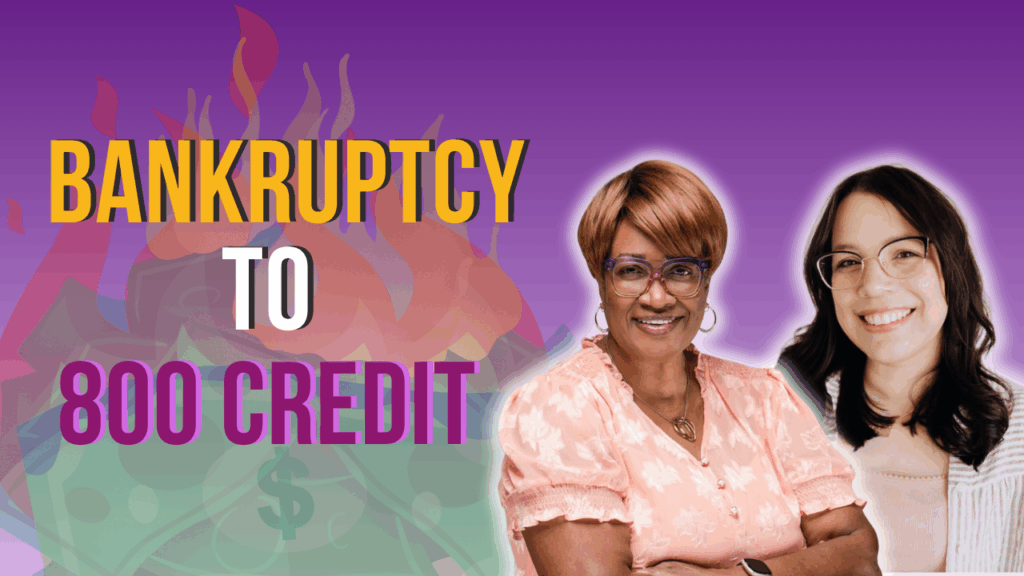
Bankruptcy isn’t the end, and it doesn’t mean your money story is over. This episode shares how one person went from bankruptcy to an 800+ credit score, proof that a fresh start is possible.
You’ll learn how to heal from money stress, rebuild credit, and start building wealth. We also talk about raising money-smart kids, breaking free from public aid, and creating a new money legacy at any age. If you’ve ever thought, “It’s too late for me,” this episode will show you it’s not.
My guest is Jasmine Lopez, an Accredited Financial Counselor® and Certified Immigrant Finance Professional. Jasmine knows what it feels like to live with financial insecurity, having faced it for most of her adult life. At 40, she drew a line in the sand and created a plan to more than double her income. She’s gone from bankruptcy to building an 800+ credit score, all while raising financially aware children.
Her journey of overcoming financial trauma has inspired her to speak nationwide, leading interactive workshops for BIPOC youth and adults on healing with money and creating abundance. Jasmine is passionate about helping others know it’s never too late to grow financially or change their legacy conversations across generations.
Connect with her here:
https://www.linkedin.com/in/yourfriendjasmine/
https://www.youtube.com/@yourfriend.jasmine
https://www.instagram.com/yourfriend.jasmine/
https://www.facebook.com/yourfriendjasminelopez
****************************************************
The Dr. Sev Talks Money podcast’s mission is to empower women to approach money confidently, reframe their financial habits, and build a future where their money is a tool for opportunity and security.
Through Dr. Sev Talks Money YouTube channel and Podcast, I provide actionable advice and inspiration to help you achieve financial freedom. Join me for one-on-one coaching, group sessions, workshops, or speaking engagements as we journey to financial empowerment together. It’s never too late to begin again—let’s make it happen!
Here is one way you can support the Dr. Sev Talks Money podcast and YouTube channel:
https://www.buymeacoffee.com/DrSevTalksMoney
My website: http://www.sevtalksmoney.com
YouTube: https://www.youtube.com/c/DrSeverineBryan–SevTalksMoney
LinkedIn: https://www.linkedin.com/in/severinebryan/
Podcast transcript
Bankruptcy isn’t the end.
Hey, hey, hey, savvy squad. Welcome to another episode of the Dr. Sev Talks Money YouTube and podcast, where we empower women to manage money confidently. Today’s guest shows us that financial healing is possible at any stage of life. My guest is Jasmine Lopez, a fellow Accredited Financial Counselor and Certified Immigrant Finance professional. Jasmine knows what it feels like to live with financial insecurity, having faced it for most of her adult life. She’s gone from bankruptcy to building an 800-plus credit score, all while raising financially aware children. Jasmine, welcome to the Dr. Sev Talks Money podcast.
Thank you for having me. I’m so honored to be here and to share my story with you.
Awesome. And I am excited to have you, a fellow Accredited Financial Counselor. So I know that you’re. You’re going to be talking my language and I’m going to be talking your language. So hopefully together we’ll be talking the language that listeners can hear and understand.
Yes, absolutely.
I think personal finance, can cause people to be a little bit uptight. So I like to introduce a little bit of fun at the beginning to loosen up the atmosphere,. So my icebreaker is, if money were a guest at a dinner party, what kind of guest would it be? The life of the party, the quiet observer, the one starting debates or something else?
Ooh, this is a good question. I would say the quiet observer. I think this guest would be someone who doesn’t necessarily flaunt what they have, but is confident in who they are, is confident in their identity, is assured in what they have to offer and doesn’t feel the need to have to like, flaunt that they have money and that they’re using it for good and building community wealth and creating change.
Yeah, I love that. I love that. Money is invited to our party at any time. Yes. So, Jasmine, tell us a little bit about you and the work that you do.
Yeah. So I am the CEO of Mentally Mutual. I love talking about money through the interconnectedness of mental well being. So our relationship, how does our emotions impact our financial decisions? And so I’ve developed a curriculum that I facilitate workshops. I speak at conferences and lead especially conversations with young adults, BIPOC young adults to talk about what is your money story? How has your lived experience impacted not just your relationship with self and others, but also money? And how do we then reframe our beliefs around money? So that then we can identify what are our joys, our values, and create a money plan that reflects that.
Yeah, I love it. And I’m sure your students love you too, because I can hear the passion in what it is that you’re doing and what it is that you want to convey to them. So let’s talk a little bit about your aha moment or that pivotal moment. You decided no more. Something has to change. What shifted for you as you turned 40?
Hmm. So I turned 40 last year. And leading up to the months of turning 40, I was like, I can’t, I can’t do this anymore. We cannot be financially insecure. We cannot be low-income as a family of five. I need to make some big changes. And in order to make these big changes, I’m going to need to double, if not triple, my income. I’m going to need to start developing and creating a retirement plan because I’ve been self-employed for my entire career as a creative entrepreneur.
I do photography, content creation and have done that since high school. And so I’ve never really held traditional jobs where I had access to Benefits or a 401k. And so turning 40 for me was like this awakening moment where I was like, shoot, I have time, but I don’t have as much time as everybody is telling me. And so I need to figure out what I’m going to do to get this together, but do it in a way that’s realistic, attainable and not shame based. And that’s been such an important process for me over the last like 18 months.
Yeah. And I’m sure that there are people listening who are close to, you know, that scenario resonates with them because they come to a point where they realize, hey, I need. Something has to change because what I’m doing is not working or it’s not going to get me to where I want to go. So bankruptcy to an 800-plus credit score is a powerful turnaround. What are some steps that you took to get here? And then what are some mindset shifts? Because we know money is more than the numbers. It really starts in the mind. What are some mindset shifts that were most important to get you here?
Yeah, so I filed bankruptcy in 2010 during the Great Recession. We lost our home, our car, and all of our possessions because we experienced also a flood in our home that created an issue with mold and so we literally lost everything. I remember the mold inspector saying, like, only take what can be washed and you have to throw out the rest. And so that was a defining moment for me. That was like, okay, this American dream is not what I’ve been told it is. And so I need to redefine and reimagine it. And initially I thought it was because I didn’t know how to budget, I didn’t know how to save. And so I started taking workshops and learning how to do all of those things.
And then in 2016, I want to say is when I had another moment where I was like, okay, I’m doing all the things, but yet we are still financially insecure, we’re still struggling, we don’t have a savings. What am I doing wrong? And I think the question of what can I change or what needs to change for me is what sparked this. The realization that there was a disconnect between my brain and my finances, and I didn’t have language for it. All I knew is that there was a disconnect. I feel like what my brain is telling me is not in alignment with how my bank account looks. So I got into therapy, started unpacking my story, healing around money, and just growing up and experiencing financial insecurity. I’ve got a financial coach who is the person who exposed me to, like, books and literature and all these different resources that existed to better understand money. And then I got and started community.
There were some women in my life who were walking through a financial journey, healing journey themselves. And so I reached out to each of them and said, hey, if we. I started a Facebook group, would we be interested in joining forces, sharing our wins, our celebrations? And together we paid off debt together, we built emergency funds, we bought homes, we started businesses, all the things. And around that time in 2018, now, I was starting a nonprofit. And then Covid happened, and just all of these shifts with our finances kept impacting us, that I was just like, okay, something really needs to change here. And realizing that a 9 to 5 isn’t going to save me, but that I needed actual strategy and I needed an actual plan if I wanted to enter into this next season of my life where I could actually thrive. The way that I was sharing with others, that was possible, but I needed to see that happen within myself and internally as well.
Yeah, that is such a powerful shift in how you’re able to maneuver through all of those things. And one of the things you said that resonated with me is community. Having people who understand what it is you’re going through, but they not only just understand, they have goals to get beyond where they are. And banding together, especially as women. We are powerful. When we work together. I mean, we are. I just don’t understand why we tear each other down.
But that’s a story for another podcast. If we band together, there is just so much power. There’s so much we can do to build each other up and push us forward into achieving the things that we desire to achieve.
Absolutely. There’s even a stat that says we’re 95% more likely to achieve a goal if we share it with somebody else. That’s powerful. And I really believe in the power of story. And doing it collectively together can truly create the kind of change we’re looking for in our communities.
Yes. Totally agree. Totally agree. Now, you and I know financial trauma is real. So how did you recognize yours and what you mentioned, therapy or were there any other steps that you took toward healing?
Yes. Oh, my gosh. Okay. Where do I start? I think the biggest thing was needing to learn how to reframe my beliefs about money. I. Something I learned in therapy were maladaptive mindsets. And my therapist.
It didn’t necessarily apply to money, but I saw how it applied to money. And there’s a maladaptive mindset that correlates to the belief of failure, of succeeding, that everybody else around me will succeed but me. And that was a mindset that I lived out of for so long that I needed really to do some deep, intentional unpacking, healing around what could be for myself, and that I, too, could succeed and that my life wasn’t just meant to be a life of struggle, but that I could thrive and that I get to define what thriving looks like, where my identity is not wrapped around how much money I have or don’t have.
Yeah, I. I love what you’ve shared about discovering you, because that’s basically it. You’re. You’re uncovering and discovering who you are. And I’m sure that there are voices that contributed to the maladaptive behavior that, you know, that thought process, because there are so many people who speak, and sometimes they’re aware, sometimes they’re not aware that the words they speak can have such a powerful effect on the people they’re speaking those words to. Sometimes it’s powerful in the negative, and sometimes it’s powerful in the positive. But for somebody who’s listening, I hope that you hear this and know that, you know, I guess again, community. And if it’s in your, you know, purview to do, go to therapy, talk to somebody, there are some places where you can get free therapeutic help, and you Know, talk to somebody to help you really see the you.
Because we are all created unique. We are unique in our fingerprints. None of us have the same fingerprints. Think about that, how unique you are and the things that you can accomplish if you discover who you really are and the power that you have as a. As a human being to go out there and accomplish the things that you desire to accomplish.
Yes. And it’s so possible, right? Like, there’s limitless opportunities. I’ve. I’ve named my curriculum Limitless Dreamer because I just want to teach as many women of color how to dream limitlessly and how to tap into creative provision and your network and your community to be able to provide for needs beyond physical dollars. I think oftentimes when we think about wealth and we think about money, we only think about it through the lens of physical dollars. But there are so many ways that we can experience creative provision beyond the tangible physical dollars. And I just want to help, like, unlock that part of our brains that says I’m not limited to how much money I have to still pursue this dream.
It is possible.
Yes, very possible. One of the things that you’ve been intentional about is raising financially aware children. What are some of the key conversations you may have had with them that other parents could learn from?
Yeah. So, you know, for me, I think going to therapy, my therapy, my first therapist was like, you know, Jasmine, you have the capacity to be adult Jasmine, to be the mom that you long and desire to be, and yet you still have the capacity to hold space for little Jasmine and to connect with her in a way that she didn’t get or receive the kind of love that she needed when she was little. And that was a huge unlocking truth that I needed to hear, that it was the both ends that I could focus on my healing while also thinking about how I could be raising my girls more intentionally. And so, you know, for the last. For eight years, we lived in the community. We’ve always lived in communities that have experienced disinvestment in Chicago land. We no longer live there.
We recently moved to Las Vegas a year ago. But prior to that, we’ve spent our entire lives in Chicago. And if you don’t know the context of Chicago, Chicago is very segregated racially, ethnically, and by class. And so we’ve lived in communities that have been impacted by disinvestment. And so having conversations around comments that our kids were seeing and experiencing and saying was an invitation for me to say, how do I help them navigate between what they’re experiencing? And seeing and not internalizing that on their own and creating falsehoods out of it, but instead invite them in to challenge and to showcase that because we’re a community that experiences disinvestment doesn’t mean we’re a bad community. That’s language I don’t like, but it’s outside voices speaking into the narrative of our communities that my children were hearing. And so then it started creating fear. It started creating their own misguided perceptions around it.
And so I felt like I needed to intentionally dive deeper into these conversations with them. I’ll never forget I had one of my kiddos ask me, mommy, are we poor? And I responded back with a curious question because oftentimes we could respond with shame and shut down these kinds of conversations with their kids. And so instead I followed up with, well, what does poor mean to you? And that turned into this beautiful conversation around how in every season of life, there’s going to be seasons where we might have a little money and there will be seasons of our life where we have a lot of money and then we value diversity in our community. And so we are going to be intentionally in relationship with others who may have more than us, the same as us, less than us. And what does it look like to live in a relationship connected and authentic and intentionally where we don’t judge or make decisions off the way someone looks or lives or how much money they have or don’t have? And so we’ve had some really beautiful conversations on this topic around financial awareness.
And yeah, yeah, it is very important to help our kids and to, even as adults to learn how to separate our identity from money. And especially in those communities where worth is often tied to financial status. Yes, it’s very important that we teach our kids and we ourselves learn that just because we don’t have money doesn’t mean you’re not a good person.
You are always you unique and wonderfully made. So. So I’m glad that you were able to have those conversations with your children. And hopefully that’s something that they will talk their friends about because you never know how they absorb that information and how it comes up in conversation and they’ll be able to share with other kids. Kids, because when we drop a pebble, it ripples. And you know, that is our hope as Parents, Right. We always want to.
Whatever we embed in our kids, we hope that it ripples out to their generation and to those around them.
Can I add something to that, too?
Yes.
I think it’s important to note that neuroscience says by the age of seven, our mindsets are beginning to form or be formed. Right. So our children are experiencing and understanding race, their understanding class, their understanding culture, in ways that they then internalize. And if we as parents and adults don’t do the healing work we need to do, that’s how generational trauma continues to pass down. So when we do this healing work, it’s an invitation to say, how can I cultivate these safe conversations on these topics? But yet it’s not just only talking, it’s also how they’re experiencing it holistically. Right. In their environment. So like I said, in Chicago, it’s very segregated racially, ethnically, and by class.
You can drive from one community to another community and see a whole shift of how houses look, how neighborhoods look, and so kids internalize that. I had one of my kids say, when will our community be happy like this community? And they couldn’t verbalize what they were seeing. But again, it was an invitation to have a curious conversation around. How do you talk to a 7, 10 year old about systemic racism and challenges and barriers that exist? It’s. It’s hard and it’s not always easy, but they have the capacity to learn about it. And they might describe it in simpler words and what they’re seeing, and yet it doesn’t mean that they’re limited to what potential opportunities are available to them. But it’s also talking about how you’re seeing it on TV culturally. Right.
In our family units and multifamily units. There’s a diversity of lived experience in there. And so it’s. How do we sense our empathy, compassion, love, cultural sensitivity in the midst of all of that? And I think that’s important to talk about that. It’s not just in conversations where money mindsets can be formed. It’s also how we experience it holistically on TV, in environments and more.
Yes. So much of that that forms our money stories, right? Yes. So I know you’re an Accredited Financial Counselor, and I think those who listen to the podcast know what that means. But you have a certification that I’d love to get into a little bit, and it’s the Certified Immigrant Finance Professional. Can you talk a little bit about that certification?
Yeah. So it’s a certification that a friend on Instagram I follow, launched earlier this year, Adina, she’s an immigrant. She’s an immigration lawyer and has a passion for helping the immigrant community. All immigrants build wealth and tap into the financial systems that exist here within the United States. And so I took her program at the beginning of this year and just really wanted to learn as much as I could around how individuals who are undocumented and have an ITIN can still leverage our financial systems and also ensure that my curriculum is inclusive to my immigrant community and neighbors. And so I was able to learn how immigrants can be able to invest buy property, you know, build credit so that they can build wealth and have access to these systems that exist here for U.S. citizens. And so it’s a program that has been really influential in the work that I do specifically because I work with BIPOC individuals and young adults.
So many of our young adults are financially independent by the age of 18. They’re first gen students. They are also carrying the financial weight that their families are experiencing, especially with the current administration and potential family separations and deportations. And so for me, it was just very important to take this certification so that I can ensure that I know how to partner well with my clients and community and neighbors and be able to leverage the information and knowledge I’m learning and take it back to my communities. That’s what’s so important to me in this financial education space is that I take what I learn and I bring it back to my communities and that I’m not just keeping it for myself.
Yeah, yeah, that is, that is so wonderful to hear because selfishness abounds in this society, especially here in the U.S. yes, I’m thankful for the blessings, but then I’m not blind to seeing the things that, that we could improve. We are such a individualistic society and it’s more, more, more, more, more. And so if you seeing that you doing that is, you know, learning, you could take that and you could build for your family, but you don’t. You’re not just doing it for your family, you’re wanting to do it for families. And, and so that is so admirable. And I wish more of us would do something like that for our community instead of just trying to, you know, build for ourselves and say, look at me, I made it, you better make it on your own.
Yeah, yeah, I think I, I don’t want to be the only one thriving in our society. Right. In our communities. I, I want all of us to collectively be thriving or flourishing together. And so, you know, these certifications are providing a Privilege for me to get access to information that I never had access to before. What good does it do me if I just keep it to myself, you know? And so I think for me, becoming an AFC, becoming a Certified Immigrant Finance professional was just this challenge within myself to say, let me take this information and give. Give it back to my community.
Yeah, yeah. I mean, anything shared multiplies. Exactly my opinion. So, yes, kudos to you. So let’s look forward a little bit. What do you hope your money legacy will be and what advice would you give listeners who want to start creating their money legacy today?
Oh, good question. I want to be able to leave a. A wealth legacy for my children and their children. And when I think of wealth, I don’t just think physical dollars. I think about it through a holistic, interconnected lens around time freedom, money, of course, but then also cultural wealth and community wealth. And so I want to instill in my children, in these next generations that we can pursue our dreams. They are possible. They are real.
How can we tap into them? How can we create and craft our lives that are interconnected with our values and our joys and be a reflection of that? And that all the good we get to experience in our lifetime is not just for us to keep to ourselves, but it’s to be generous with and to give on to others. I really hope that that is a legacy that my children take and move on. But then also I think about the legacy of my community. Right. I haven’t mentioned it, but I started a nonprofit along this way back in 2018 as well, that’s connected with BIPOC youth. And I think my legacy for that is this desire for our community to see what it looks like for neighbors, to help neighbors, and that it doesn’t take someone to come into our communities to provide the solutions, but that those of us experiencing it and most impacted by the challenges we’re seeing daily, we are the solution to our community. And so how do we band together our resources, our time, our knowledge to create that change? And so I hope that the young adults who have experienced our programming and the work that I’ve been doing through the Firehouse Dream get to have this again, this ripple effect where then they create generational change within their own families from generation to generation.
Yeah. Yes. Yes. Wonderful. Any final thoughts that you’d like to share with our listeners?
Yeah, I think, you know, it’s never too late. It’s never too late to get started on your money healing journey. It’s never too late to start investing and creating a wealth plan be encouraged. I hope that you see through my story that while, you know, 18 months ago, I’m starting to build my own retirement plan and investing, I have made huge strides in progress and taken the steps along the way. And it’s possible. It’s possible for us. And I would invite you to dream limitlessly about what it could look like to craft the kind of life that you are deeply proud of and that is connected to your joys and your values.
Yes. Yes. So I’d love for the listeners to connect with you and I’m sure there are those that are listening who would love to connect with you. What is one of the best places that they can connect with you? And then of course, I’ll share the rest of it with within the show notes. But what is maybe the best place to connect with you?
Yes. So I am the most on Instagram. My personal finance brand is under @yourfriend.jasmine and I connect all my content through there through my business Mentally Mutual. But you can find me on Instagram @yourfriend.jasmine.
And I’ll have the rest of her connections in the show notes. Jasmine, thank you so much for joining me here on Dr. Sev Talks Money sharing your story, sharing that it’s never too late to build or rebuild your financial life.
Friends, if today’s conversation resonates with you, don’t keep it to yourself. Share this episode with someone who could use a little encouragement on their own money journey. As you heard Jasmine talking about the ripple effect, each one, teach one. And we can build a village, we can build a community when we share what we know and help each other. So as we wrap up, please remember to subscribe to the podcast on YouTube. If you listen on Apple podcast, leave a review and a rating. If you listen on Spotify, leave a rating. And as you are completing your rating, please remember that we love the number five.
Until then, this is Dr. Sev saying stay savvy and we’ll see you next time.